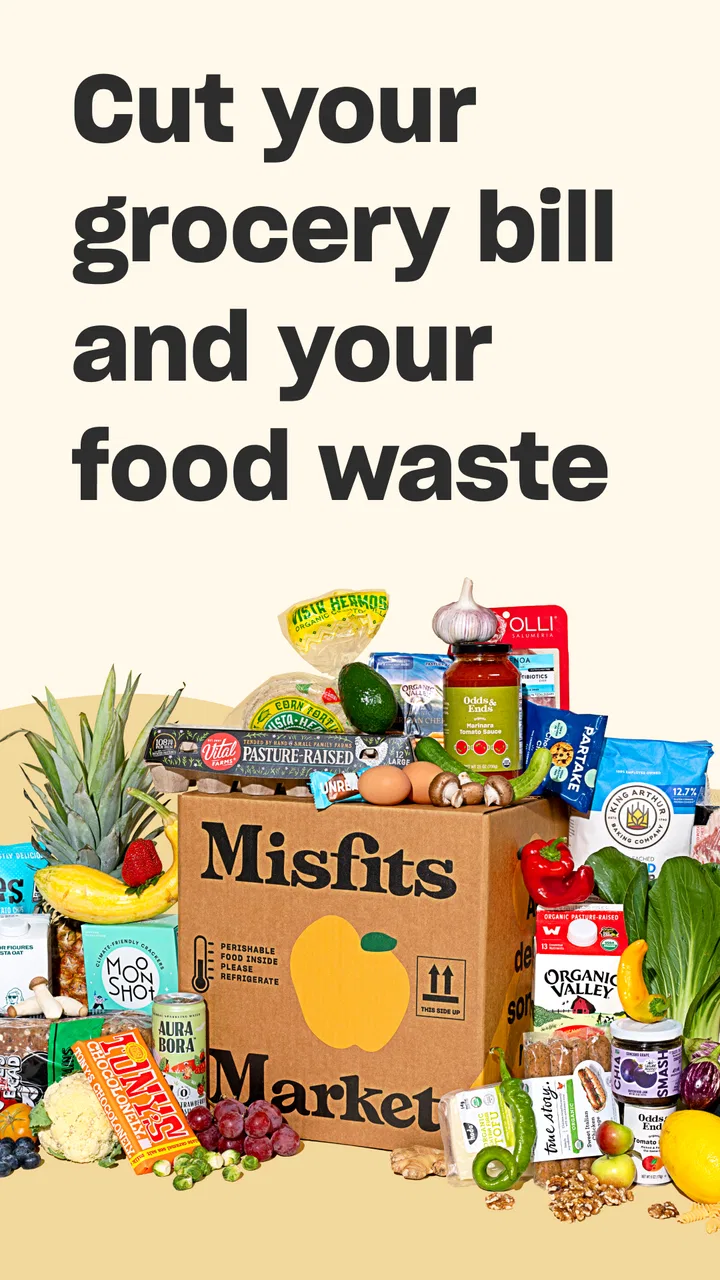
Misfits Market Grocery App
- 4.3
- Rating
- 100.00K
- Installs
- Free
- Price

 Analysis by App-foxy
I approached Misfits Market as a practical grocery-shopping tool rather than just another delivery app. Its focus is organic grocery delivery, and that gives it a more specific purpose than a general supermarket app: it is aimed at people who want to bring pantry staples and fresh food into their routine without making a separate trip to a store. After spending time with it, my impression is positive, but conditional. It can make planned grocery shopping feel easier, especially when quality and convenience matter, yet it is not the best fit for every kind of shopper.
The app is free, carries an Everyone content rating, and comes from Misfits Market. It sits in the Food & Drink category and has built a respectable audience, with an average rating of 4.4 from roughly 3.8 thousand ratings. That tells me it has moved beyond being a curiosity, while the 100K+ installs suggest a meaningful number of people are using it for real shopping rather than merely testing it once.
How the current shopping experience feels
The strongest part of the experience is the way it encourages me to shop with a plan. Instead of wandering through a physical supermarket and adding whatever catches my eye, I can think in terms of the next few meals, the household basics that are running low, and the organic items I actually expect to use. That shift sounds small, but it changes how I make decisions. I am less likely to buy something simply because it is in front of me.
You May Also Like

 Blood Strike: 2.5 Anniversary
Blood Strike’s Loadouts Turn Every Drop Into a Tactical Gamble
A close look at Blood Strike’s custom loadouts: how fast access to signature weapons reshapes its battle royale rhythm, rewards preparation, and narrows the gap between fights.

 Pandora - Music & Podcasts
Pandora’s Music Is Easy to Start, but Harder to Recover
Pandora’s strength is its low-effort path from a seed to a station. Its weak spot is how much confidence it asks you to place in connection, setup, and quiet recovery.

 8 Ball Pool
 Is Built on Rivalries, Rematches, and Routine
A close look at the rivalries, rematches, shared routines, and unanswered safety questions that turn a quick pool match into a persistent mobile community.

 Samsung Music
’s Quiet Strength Is Playing What You Already Own
Its reach comes less from spectacle than from dependable access to a personal library. That simplicity is both the app’s strongest retention engine and its ceiling.

 AccuWeather: Weather Radar
AccuWeather Review: A Quick, Clear Forecast for Everyday Decisions
For everyday plans, the best forecast is the one you can understand quickly. AccuWeather makes rain timing, radar, and local conditions easy to act on, with a few trade-offs.

 Hill Climb Racing
Why Hill Climb Racing Still Turns Crashes Into One More Run
A tiny car, a bumpy hill and one more upgrade: Hill Climb Racing keeps resurfacing because its simple chaos makes every near-miss feel personal.
More From Our News Desk



For a busy weekday, the appeal is easy to understand. Imagine noticing on Monday evening that breakfast supplies, vegetables, and a few cupboard essentials will not last through the week. A grocery delivery app can save the drive, parking, and time spent walking through several aisles. The useful part is not only convenience; it is being able to build the order around a household routine instead of treating shopping as an unplanned errand.
I also like that the app has a clear identity. Many supermarket apps try to do everything at once, including loyalty programs, store maps, pharmacy tools, coupons, and local pickup. Misfits Market feels more focused on the food order itself. That narrower purpose can be an advantage when I already know I want groceries delivered and do not need a digital copy of an entire supermarket.
Still, a focused grocery app requires me to be more deliberate. I need to check what is available, consider whether the selection suits my meals, and avoid assuming that every item I normally find in a nearby store will be there. The experience rewards planning more than improvisation. If I decide at the last minute that I need one specific ingredient tonight, a conventional local store may be faster and more predictable.
Who gets the most value from it
I would recommend trying it to people who regularly buy organic groceries, prefer delivery to crowded stores, or want a more structured way to manage weekly food shopping. It may also suit households that already think in larger planned orders rather than making several small trips. Parents, remote workers, and anyone with a packed schedule can benefit when avoiding one supermarket visit makes the difference between cooking at home and ordering takeout.
The app is less convincing for someone who shops almost entirely for immediate meals. If my list is only milk, a particular brand of pasta, and one fresh item for dinner, I would probably choose a nearby supermarket or a fast local delivery service. The same applies to shoppers who need complete control over substitutions, exact ripeness, or a very specific set of brands. A broad supermarket app generally offers more familiar depth, while Misfits Market is more appealing when the overall shopping mission matters more than one exact product.
There is also a difference between wanting organic food and wanting the lowest possible grocery bill. The app’s appeal is tied to its food focus and delivery convenience, not simply to finding the cheapest option in every situation. I would compare the final basket with my usual alternatives instead of assuming that a specialized service automatically costs less. Delivery can save time, but time savings and financial savings are not always the same thing.
Small habits that make ordering easier
My first practical tip is to begin with a short, repeatable list rather than trying to recreate an entire supermarket trolley immediately. I would choose the items I buy most often, see how well the available selection fits my routine, and then expand from there. This makes it easier to judge whether the service genuinely replaces a shopping trip or merely adds another place to check.
A second useful habit is to plan meals before opening the app. I find grocery apps more helpful when I already know whether I am buying for breakfasts, packed lunches, quick dinners, or pantry backup. Without that plan, browsing can become the same kind of impulse shopping I was trying to avoid. With it, I can evaluate each item by asking a simple question: will this be used soon, or does it only look appealing right now?
I would also keep a separate note of non-negotiable items. These might be a particular ingredient, a dietary staple, or something needed for a recipe on a fixed day. That note helps me identify early whether Misfits Market is suitable for the whole order or better used for part of it. This is one of the more important trade-offs: the app can be useful without becoming the only grocery source in the household.
Another overlooked point is timing. Delivery shopping works best when I order before the kitchen is completely empty. If I wait until the last serving is gone, the convenience disappears because I may still need to make an urgent store run. I would treat the app as part of a weekly rhythm, not as an emergency replacement for a nearby shop.
What the recent version says about its direction
The current version is 3.3.26, and the app was released on March 24, 2022. Those details place it in a product phase where ongoing refinement matters more than novelty. I do not see it as a one-off concept; it has had time to establish its basic shopping workflow and continue evolving. For a grocery app, that kind of continuity is important because reliability and clarity are more valuable than flashy features.
What I notice most in a mature grocery app is not a single dramatic change but whether the basic journey remains understandable: opening the app, finding suitable food, building an order, reviewing the basket, and knowing what happens next. A version update is useful when it reduces hesitation in those moments. It should help me make decisions with less friction, not make me learn a completely different shopping method every time I return.
I would be careful about treating the version number as proof that every part of the service has changed. A current release can reflect maintenance, compatibility work, interface adjustments, or gradual improvements that are not obvious from a quick session. My own judgement is therefore based on the present experience: the app’s value comes from its focused grocery purpose and the convenience of planning delivery, while the exact benefit of any individual update depends on which part of the workflow I use most.
For existing users, the most encouraging sign is continuity. Someone who already understands the service should be able to return to the same general idea—organic grocery shopping through a dedicated app—without feeling that the product has abandoned its original purpose. That matters more here than adding unrelated tools. A grocery app earns trust when it helps me complete ordinary orders consistently.
New users should still allow themselves a short adjustment period. The first order is when I learn whether the available selection suits my household, how much planning I need, and whether delivery fits my schedule. I would not judge the app solely by the first few minutes of browsing. The better test is whether it makes the next grocery cycle simpler and whether the food I order actually fits the way I cook.
Where it compares well with ordinary alternatives
Compared with walking into a supermarket, Misfits Market removes travel and makes it easier to shop from a prepared list. That is its clearest advantage. I can avoid the distractions of the aisles and make the order from home, which is especially useful when the trip itself is inconvenient. The trade-off is that I lose the immediate visual check I get in a store, along with the ability to pick the exact package from a shelf.
Compared with a broad supermarket app, this service feels more purpose-built around its organic grocery identity. A supermarket app may win when I need a huge catalogue, a specific brand, or a last-minute item from a nearby location. Misfits Market can win when I want a more curated shopping mission and do not want the digital equivalent of walking through every department.
Compared with buying organic food in person, delivery adds convenience but also makes planning more important. In a store, I can change dinner based on what looks good and carry the food home immediately. In the app, I am making a forward-looking decision. That can be a strength for organized shoppers and a weakness for people who enjoy spontaneous cooking.
I would also distinguish it from meal-kit services. Misfits Market is better suited to people who want to choose their own groceries and retain control over how they use them. A meal kit may be easier for someone who wants recipes and preselected portions, while this app makes more sense when I already know my household’s preferences and want ingredients rather than a fixed cooking plan.
The gaps I would consider before switching
The biggest limitation is the natural uncertainty of online grocery selection. A digital list can look convenient, but it cannot fully reproduce the judgement I make in a store when choosing produce, checking packaging, or changing my mind at the shelf. Anyone who is particular about exact appearance or condition should think about whether delivery convenience outweighs that loss of control.
Another gap is the possibility of needing a backup shopping habit. I would not rely on one delivery order for an important meal until I had learned how well the service fits my routine. Keeping a local supermarket as a fallback is sensible, especially for ingredients tied to a fixed occasion. That is not a criticism unique to this app, but it is a real part of using any specialized grocery service.
There is also the question of household size. A single person or couple may find planned delivery easy to manage, while a large household can have more complicated needs and faster-changing lists. The more exact the order must be, the more valuable a broad supermarket catalogue may become. Misfits Market is strongest when I can accept a little flexibility in exchange for a simpler shopping process.
I would skip it if I mainly need immediate local availability, shop based on daily inspiration, or want the absolute broadest choice of brands and formats. I would also be cautious if I dislike comparing baskets and prefer one store that handles every category under one account. The app’s specialization is useful, but specialization always means I should check whether it matches my priorities rather than assuming it will replace every alternative.
What I would watch as a regular user
If I continued using the app, I would watch how well it supports repeat shopping. The first order can be interesting, but the real test is the third or fourth cycle, when I want to rebuild a familiar basket without unnecessary work. A good grocery routine should become calmer over time. I would pay attention to whether returning to regular items feels quick and whether browsing remains helpful instead of becoming a chore.
I would also watch how clearly the app communicates the practical parts of an order. Grocery delivery depends on confidence: I want to understand what I am selecting, what belongs in the final basket, and when I should expect the order. Clear information reduces the need to second-guess a purchase. If the app keeps that process straightforward as it evolves, its everyday usefulness should remain strong.
For current users, the best approach is to judge updates through the lens of routine rather than novelty. Does the app help me plan better? Does it make repeat orders less tiring? Does it continue to serve the organic grocery purpose that brought me there? Those are more meaningful questions than whether a new release simply looks different.
For someone considering a first download, the decision is fairly simple. The app is free, supports an Everyone audience, and is worth testing if organic grocery delivery fits the way you shop. I would start with a manageable order, compare it with my normal supermarket routine, and evaluate the result by convenience, selection, and how much planning it demands. That approach gives a more honest answer than judging it from the store summary alone.
My final view is that Misfits Market is a useful specialist rather than a universal grocery replacement. I like it most for planned organic shopping, busy weeks, and households that are comfortable choosing groceries ahead of time. I would choose a conventional supermarket app when I needed a very specific item, immediate availability, or the widest possible range. Used for the situation it handles best, this Food & Drink app can turn a recurring errand into a more organized part of the week. Its real strength is not removing every grocery decision, but making planned delivery feel like a practical habit.
FAQs for Misfits Market Grocery App
01What is Misfits Market and how does it work?
Misfits Market is a grocery delivery app that provides users with discounted, high-quality produce and other groceries that might not meet the cosmetic standards of traditional retailers. Users can browse through a selection of fresh produce, pantry staples, and more, all at a reduced price. After selecting their items, users choose a delivery slot and receive their groceries directly to their doorstep.
02Is Misfits Market available in my area?
Misfits Market is expanding its delivery zones across the United States. To check if it's available in your area, you can enter your zip code on their website or app. If they aren't currently servicing your location, you can sign up for notifications to be alerted when they expand to new regions.
03Are the products from Misfits Market safe and high-quality?
Yes, all products from Misfits Market are safe and meet quality standards. The app focuses on reducing food waste by offering items that are perfectly good to eat but might not be visually perfect. This includes slightly misshaped produce or items nearing their sell-by date, ensuring that all products are fresh and safe for consumption.
04How does Misfits Market pricing compare to traditional grocery stores?
Misfits Market offers competitive pricing, often lower than traditional grocery stores. The app provides discounted rates because it sources items that might otherwise be wasted due to cosmetic imperfections. Users can expect to save a significant amount on their grocery bills while supporting sustainability efforts.
05What payment methods does Misfits Market accept?
Misfits Market accepts a variety of payment methods including major credit and debit cards. They may also accept digital payment options like PayPal or Apple Pay, depending on updates and regional availability. Users can securely store their payment information on the app for a seamless checkout experience.
Pros
- Wide selection of organic products.
- User-friendly interface for easy navigation.
- Weekly deals and discounts available.
- Flexible delivery options to fit your schedule.
- Sustainable packaging and eco-friendly practices.
Cons
- Limited delivery areas can restrict access.
- Occasional stock shortages on popular items.
- App notifications can be overwhelming.
- Price may be higher than local options.
- No in-app customer service chat available.

Misfits Market Grocery App
Gallery